Deloitte Releases Survey Results: Brand Is Not a Key Factor in Car Purchase Decisions
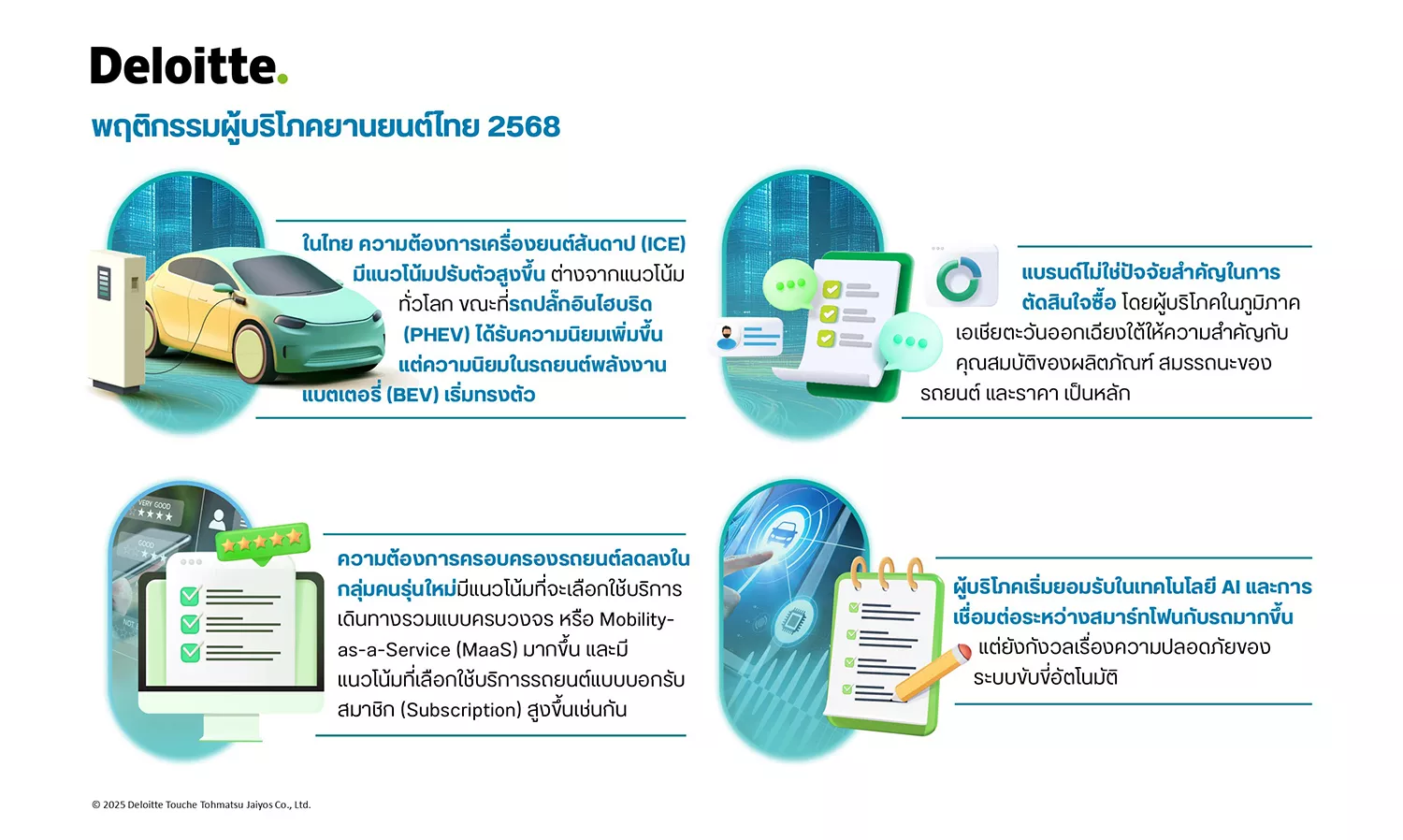
- The data indicates that in Thailand, the demand for internal combustion engines (ICE) is trending upwards, contrasting with global trends. Meanwhile, plug-in hybrid vehicles (PHEV) are gaining popularity, but the interest in battery electric vehicles (BEV) is stabilizing.
- Brand is not a crucial factor in purchasing decisions, as consumers in Southeast Asia prioritize product features, vehicle performance, and price.
- Among younger generations, the desire to own cars is decreasing, with a tendency to opt for comprehensive mobility services, or Mobility-as-a-Service (MaaS), and a rising interest in subscription car services.
- Consumers are increasingly accepting AI technology and smartphone connectivity with vehicles, yet they remain concerned about the safety of autonomous driving systems.
Deloitte Thailand has released the 2025 Global Automotive Consumer Study: Southeast Asia Perspectives, which surveyed over 6,029 consumers across six Southeast Asian countries, including more than 1,000 consumers in Thailand. The findings reveal interesting consumer behaviors that differ from global trends, particularly the increasing demand for ICE vehicles while brand loyalty is shifting.
Additionally, unique consumer behaviors in Thailand show a preference for trusting car dealers over manufacturers for vehicle information management. These findings highlight challenges and opportunities for automotive ecosystem players to adjust strategies to meet increasingly complex consumer demands.
When Consumers Do Not Follow the EV Trend Alone
Despite the industry's shift towards electric vehicles (EV), the survey indicates that consumers in Southeast Asia are increasingly favoring internal combustion engines (ICE) compared to the previous year.
In Thailand, the demand for ICE has risen from 32% to 36%. Notably, the popularity of plug-in hybrid vehicles (PHEV) has significantly increased from 17% to 21%, reflecting that Thai consumers are seeking flexible options to meet practical usage needs.
The survey found that concerns regarding battery electric vehicles (BEV) in Thailand include price, driving range, and charging time. However, concerns about the lack of public charging stations have significantly decreased from 46% last year to only 26% this year, possibly reflecting increased confidence in the country's charging infrastructure. Additionally, the survey indicated that 46% of Thai consumers, the highest in the region, expect charging from 0-80% to take no more than 20 minutes.
When Brand Is Not the Main Factor, But Quality and Performance Are
The survey also revealed that brand loyalty is changing. 43% of Thai respondents stated they used the same car brand as their previous vehicle, but when asked about their next car purchase, 67% of Thais are open to switching to another brand. This aligns with the regional trend where 70% of consumers are more willing to consider new options. The top three most important factors are product features, vehicle performance, and price, while brand image and familiarity rank fifth and sixth in purchase decisions, indicating that today's consumers prioritize tangible value over brand considerations.
Complex Expectations and the New Role of Dealers
The survey indicates that Thais want to minimize the necessity of visiting dealers in person, with this preference jumping from 36% last year to 73% this year.
Meanwhile, 93% still insist on experiencing the actual vehicle before purchase, and 90% want to test drive, reflecting a desire for a seamless hybrid purchasing experience between online and offline.
Moreover, compared to other Southeast Asian countries, Thais place the highest importance on locally assembled vehicles, with 71% considering it a crucial factor in their car purchase decisions, reflecting confidence in the quality of vehicle assembly in Thailand.
Additionally, Thais trust car dealers more than manufacturers to manage vehicle information, reinforcing the significant role of the dealer network in the Thai market, which differs from other Southeast Asian countries where consumers primarily trust manufacturers.
Real Usage Patterns and Expectations for Electric Vehicles
The survey also reveals the driving patterns of Thais, with nearly half (48%) driving over 100 kilometers more than five times a month, and 49% using personal vehicles daily. These behaviors reflect the need for high-performance and reliable personal vehicles among Thai consumers.
Specifically regarding expectations for BEVs, 40% of Thai consumers expect a driving range of over 400 kilometers per charge. The most important factors for charging vehicles outside the home are fast charging time (22%), followed by personal safety (15%) and easy accessibility (15%).
MaaS and Subscription Services on the Rise
Among consumers aged 18-34, there is a clear trend of decreasing interest in owning personal vehicles, with a shift towards comprehensive mobility services, or Mobility-as-a-Service (MaaS), to meet their needs.
Thailand ranks third in Southeast Asia (55%) for young people's interest in this service, following Vietnam (67%) and Indonesia (58%). This aligns with the rising interest in subscription car services, where Thailand ranks second in the region (49%), behind Vietnam (66%).
Technology and Trust
Consumers in Southeast Asia are broadly accepting technology that facilitates automotive convenience, with 75% of Thai consumers viewing the use of AI technology in automotive systems as beneficial, the third highest in the region, following Vietnam (84%) and Indonesia (78%).
Similarly, smartphone connectivity is also highly valued, with 74% of Thai consumers considering it important. However, consumers in the region express concerns about the future role of technology in directly controlling driving.
The survey found that nearly half of consumers in the region are concerned about the availability of driverless cars (Robotaxi) in their neighborhoods, and this concern increases for commercial autonomous vehicles on highways, even though neither Robotaxi nor commercial autonomous vehicles are currently available in the region.

Mr. Songjin Lee, Southeast Asia Automotive Sector Leader at Deloitte Southeast Asia, stated, “The automotive industry is a large sector with a complex and deeply rooted ecosystem. When changes begin to occur, they will have significant and long-lasting impacts. Therefore, it is essential to consider consumer perspectives, needs, and readiness as a fundamental basis. However, consumer behavior is rapidly changing and evolving. Buyers are starting to view cars not just as long-term investment assets but as products that must meet current needs and adapt to frequent changes. This trend indicates that cars may evolve into fast-moving consumer goods (FMCG) that are purchased and circulated more quickly in the future.”

Mr. Mongkol Somphol, Automotive Sector Leader at Deloitte Thailand, added, “Although the atmosphere in the automotive industry, especially in Thailand, may not seem as vibrant as in the past, it is crucial to recognize the ongoing changes that are not only challenges but also present new and interesting opportunities for businesses and operators in related industries, leading to growth and competitiveness in this rapidly changing market.”
Dr. Chodok Panyawaranant, Senior Manager of the Growth Department at Deloitte Thailand, concluded, “Consumers are more sensitive and changeable than expected. Offering comprehensive products and services that meet all consumer needs may be a safer option than focusing on developing just one aspect.”
For those interested, the full report of the 2025 Global Automotive Consumer Study: Southeast Asia Perspectives is available at: https://www.deloitte.com/southeast-asia/en/Industries/automotive/perspectives/global-automotive-consumer-study-2025.html